"I'll Get to It Someday" — The Swedish App I Made for Myself
2026-06-18
The other day, halfway through messing around with Claude Code, I got the urge to build a Swedish-learning app just for myself. And then, in one evening, it was actually done — and live.
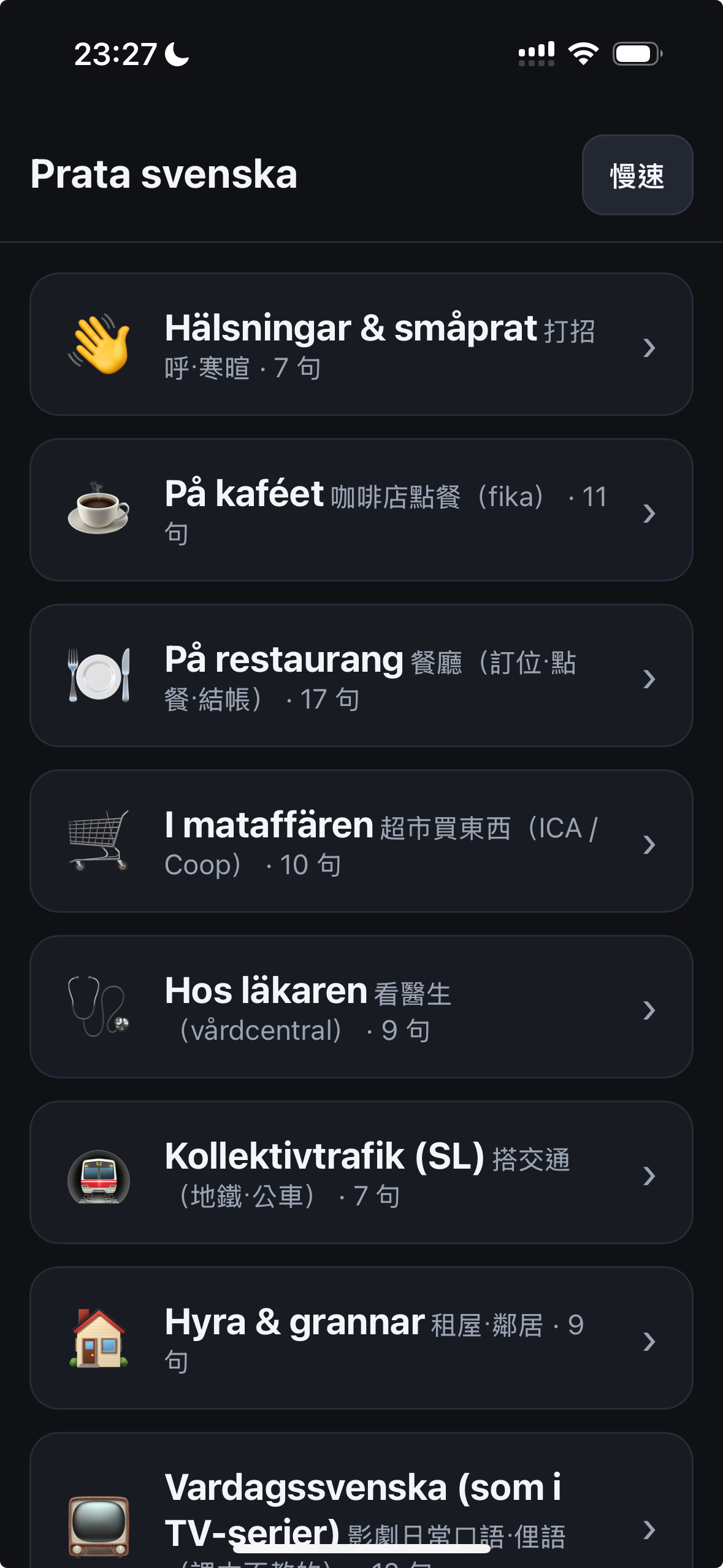
The home screen — each scenario is a stack of sentences you tap to hear.
It’s a very simple design: tap a sentence, hear its audio. I didn’t want flashcard drills, I didn’t want quizzes, I didn’t want games — I just wanted something like Anki, except without having to type everything in by hand or hunt down someone else’s pre-made deck. At its core it’s just a static website — a pile of HTML, CSS, JS, one JSON file holding the sentences, a folder of audio, no backend; you open the URL on your phone, add it to your home screen, and it looks like an app. I figured I could probably cobble it together and hand-code it slowly — but to actually build it from scratch myself would still be hard, and take a lot of time.
So why hadn’t I done it before?
What stopped me was “ugh, just thinking about the organizing makes me tired”
The idea had flickered through my head sometime last year. I love one particular feature of a certain Swedish-learning app, and I’d been waiting forever for them to take my feedback and ship it — so why not just gather the sentences I actually want to learn myself, get Philip to record them, and keep his voice somewhere I can pull up anytime? Hearing him is so much warmer, so much more motivating, than some stranger’s voice.
The idea was clear. But what came up next, automatically, was this long list of prep work. Everyday phrases, plus all the numbers — even a rough count already adds up to three hundred-plus sentences, which means three hundred-plus audio files. Just renaming each file to match its sentence ID would eat up days, and get one wrong and the whole thing won’t line up — mind-numbing and so easy to mess up. Record one badly, you re-record; after re-recording, you have to re-match it all over again. I can’t even type or spell in Swedish yet — I’d be fumbling at the keyboard, entering them one by one.
By the time I’d thought that far, the idea had already shut itself off in my head.
So what stopped me was never “can I write it.” It was that just the thought of organizing all that busywork wore me out — same as always, I hate dealing with admin chores.
I think this distinction matters, because honestly it cuts a little deep. If what stopped me were ability, that’s a clean “I can’t,” and there’s nothing more to say. But if what stopped me is “I couldn’t be bothered to organize it,” then it means: I always wanted the thing, and I could always have done it — I just didn’t want to pay the boring middle part. That’s a lot harder to admit than “I can’t.” Kind of embarrassing, really.
What AI took away was exactly that boring part
The process this time was so casual it’s almost funny.
I literally just told Claude: “I want to make a Swedish app. Please generate a list of sentences — I only want to record them with the Mac’s Voice Memo. Help me figure out how.”
Once I’d recorded them, I dropped the audio straight into a folder Claude Code could read, and Claude suggested installing the offline whisper.cpp to transcribe — outputting the Swedish text directly and matching it against the recordings.
(It’s the offline model made by Georgi Gerganov, running on your own computer; the audio never gets uploaded anywhere.)
I quickly saw the beauty of this flow: wherever Philip thought my script was off, he could just record the correct version over it, and I didn’t even need to write the corrected text down. whisper.cpp would parse the newly recorded audio and fix the script to match what he actually said — which meant that from then on, if I wanted to add a sentence, I could just record it. No need to maintain a script at all. Like this —
The pre-written script says: “I’d like an Americano,” — but I don’t even like Americanos, I’d never use that, so I can just have Philip record it as: “I’d like to order an oat-milk latte, iced, to go.”
The text got parsed in an instant, and I didn’t have to rename a single audio file by hand, or write anything back into the corresponding code.
It was just that smooth!
The sentences I forgot to record could even be filled in with a Siri machine-voice placeholder generated by Claude, to be swapped out later when Philip has time. The friction of building had vanished — and so had my reason for never building things, which was that I’m lazy.
There were a few small annoyances along the way — Voice Memo can’t batch-move files, so I had to dig into the hidden recordings folder and copy the waveform and mp4 files into my dev folder to process them; after deploying, I hit an error 400, a completely blank page when it first went live, the recorded-audio detection failing. But all of it I could fix by asking Claude as I went, and none of it caused much trouble.
So what do I actually want to make?
But now that someone’s solved the hard part of building for me, and cleared away the boring part of the process too — what is it I actually want to create?
My old “can’t be bothered to organize” mindset had quietly been shielding me from this question. As long as an idea hasn’t been built yet, it can stay forever in the “I’ll get to it someday” state, never put to the test. While the friction of building was there, I could keep pretending I had all these things I wanted to do — I just didn’t have the time, or Philip didn’t have time to write it for me.
With the friction gone, that excuse is gone too: I can’t blame the hassle for why I didn’t make it, so all that’s left is — what do I actually want?
This Swedish-learning app will never have any user but me, and it makes no money. I made it purely because I want to use it.
Philip’s voice is private, and putting it on a public URL makes me uneasy, so I built in a few extra things: an obscure URL, set to stay out of search engines, the recording-list page kept off the live site and only on my own machine, and so on.
The app even has a folder just for the phrases I plan to use to communicate in Swedish when it’s not convenient to speak openly in public… all of these private-only features are exactly what stop me from putting the site online. And since it can’t be published, of course it doesn’t give me that thrill of trading ideas with a community the way something like Ljusväg Tarot or Cafe and Cowork does.
Thinking about it afterwards, this actually reveals what I really wanted out of making this app. I didn’t want a Swedish-learning tool — there are plenty of those, plenty done better than mine.
What I wanted was something in Philip’s voice, holding the little ways we talk to each other, something that belongs only to me. Learning the language is the surface; the thing tucked inside “Miscellaneous · Other” is the real heart of it.
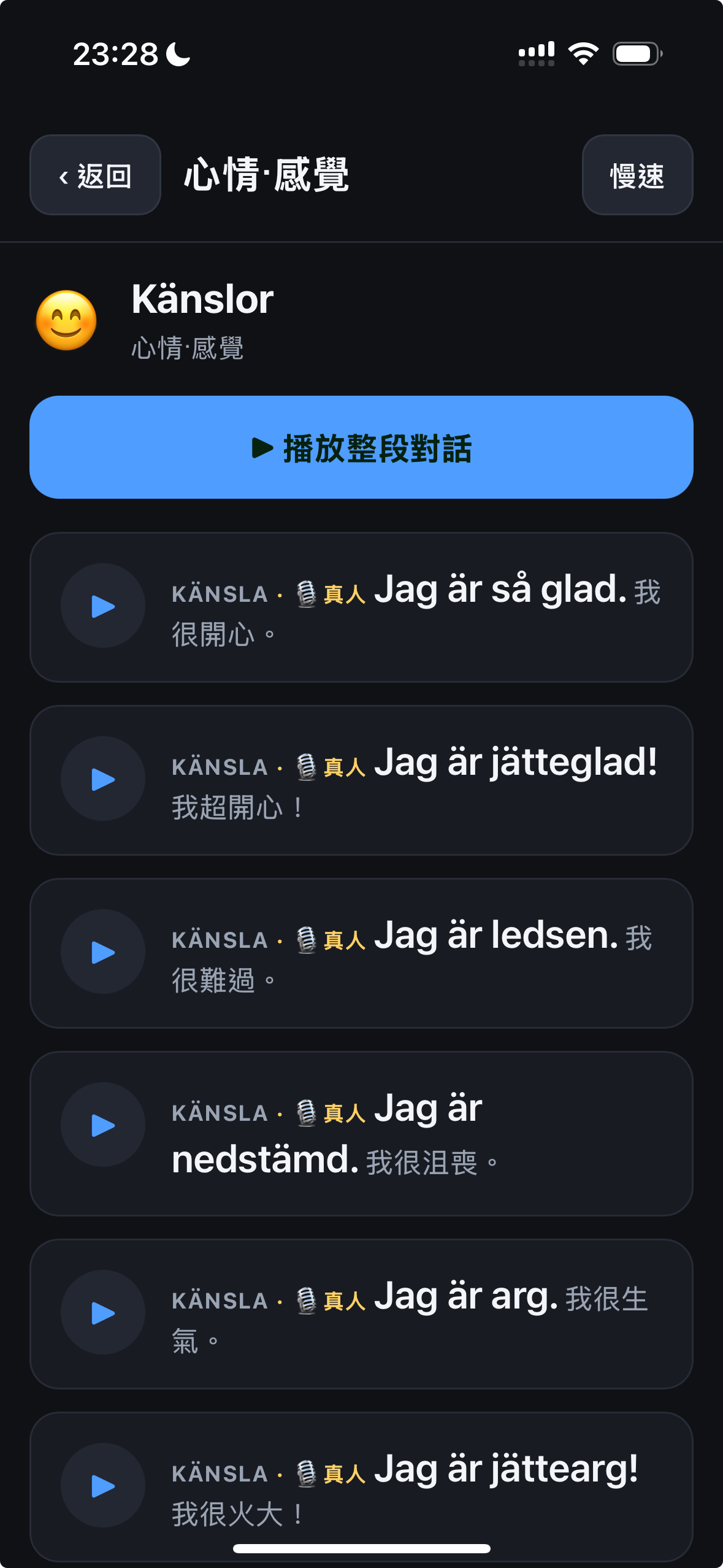
The “real voice” tag next to each line is Philip.
(While testing it these past couple of days, I found an even funnier use — using it as my voice box: when I want to respond, I just tap a button, like those “talking dogs” that press physical buttons to express themselves. Brilliant.)
I don’t know yet what else I want to make — but for me, being able to honestly face that question, and then make a little thing that’s perfectly fine having no users at all, is already the best gift this era has given me. So if you, too, have an idea that’s been parked forever at “I’ll get to it someday,” I’d say: that “someday” is a lot closer than you think. It doesn’t have to be made for anyone else to see — making it for yourself is enough.
And if you get stuck, leave a comment; let’s figure it out together :)